Dashed Lined Ruled Tracing: A Guide to Handwriting Success
Understanding the Visual Style and Purpose
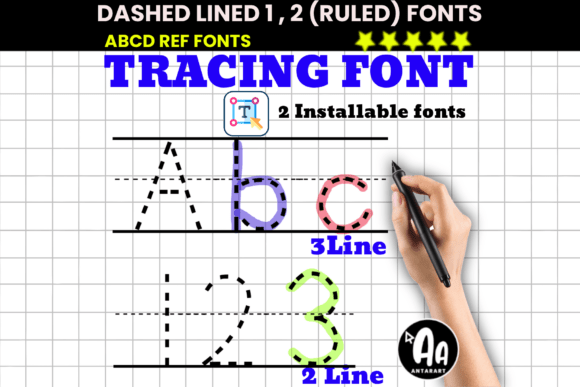
At its core, Dashed Lined Ruled Tracing is a specialized typographic tool rather than a standard decorative typeface. It is specifically engineered to solve a fundamental problem in early childhood education: how to teach letter formation and spatial awareness simultaneously. Visually, the font presents characters not as solid strokes, but as connected dashed or dotted lines. This design choice mimics the traditional "connect-the-dots" method, allowing young learners to see the path a pencil should take to form a specific letter.
What sets this premium font apart is the integration of ruled baselines directly into the character design. The set includes both 2-line and 3-line options, which are critical for teaching concepts like the "waist line" and "descender line." When you type using this font, the guidelines appear beneath the text automatically. This ensures that students learn not just the shape of a 'b' or a 'd', but exactly where that letter should sit on the page. The personality of the font is purely functional, clean, and instructional, prioritizing clarity over stylistic flair.
Strategic Applications in Educational Design
For publishers, educators, and content creators in the education sector, Dashed Lined Ruled Tracing serves as a foundational design asset. Its primary application is in the creation of printable practice sheets and handwriting workbooks. Because the lines are built into the font, you can bypass the tedious process of drawing separate guide lines in design software like Adobe Illustrator or Canva. You simply type the text, and the structure is there. This drastically speeds up the production of classroom resources, from alphabet practice pages to back-to-school review packets.
Beyond standard worksheets, this font family offers versatility for various classroom materials. Consider using it for:
- Editable Student Name Templates: Create personalized desk tags or cubby labels that students can trace throughout the year.
- Bulletin Board Displays: Print large-scale letters for bulletin boards that mimic the style students are learning to write, reinforcing visual recognition.
- Interactive Learning Games: Design flashcards or "trace and erase" activities using laminated sheets.
The inclusion of numbers (0-9) and common symbols further extends its utility into math worksheets and early coding logic exercises, making it a comprehensive resource for early elementary curriculum design.
Integrating Tracing Fonts into Modern Branding and Marketing
While Dashed Lined Ruled Tracing is an instructional font, its application extends into marketing and branding for businesses targeting the parenting and education demographics. If you are a small business owner selling educational toys, homeschool supplies, or children’s stationery, this typeface can significantly enhance your brand identity. Using it in your packaging design or social media graphics immediately signals to your audience that your product is child-friendly and educational. It creates an instant visual connection with the experience of learning to write.
When incorporating this font into your marketing assets, readability and hierarchy are paramount. Because the characters are dashed, they naturally create a lighter visual weight than a solid sans serif font or serif font. Therefore, it should be used sparingly for headlines or accent text rather than body copy in a brochure. A strong font pairing strategy is to combine Dashed Lined Ruled Tracing with a friendly, rounded sans serif for the main text. This maintains the playful, educational vibe while ensuring your marketing message remains legible and professional.
Technical Flexibility and Workflow Efficiency
One of the most significant advantages of this font set is its seamless integration into standard creative workflows. As an installable creative font, it functions across all major operating systems and software. Whether you are designing a workbook in Microsoft Word, laying out a PDF in Adobe InDesign, or creating quick graphics in Paint or Inkscape, the font behaves exactly like any other typeface. This eliminates the need for complex vector manipulation or layering guide images behind text.
For web designers and digital content creators, this compatibility allows for the creation of consistent assets across print and digital formats. You can design a printable PDF worksheet and a corresponding social media graphic using the exact same typeface, ensuring your brand identity remains cohesive. The font supports uppercase and lowercase letters, providing the full range of characters necessary for comprehensive English language practice. However, it is important to note the technical limitation regarding language support: the current set does not support Spanish characters, which is a crucial consideration for bilingual curriculum designers.
Choosing and Testing the Right Font Pairing
When selecting Dashed Lined Ruled Tracing for a project, you must evaluate the specific needs of your target audience. If your goal is to create materials for pre-K students just starting with fine motor skills, the 3-line version with distinct ascender and descender zones is likely the best choice. For older students focusing on cursive or simplified print, the 2-line version may offer a cleaner look.
Effective font pairing is essential to prevent your designs from looking disjointed. Avoid pairing this dashed font with highly ornate script fonts or distressed handwritten fonts, as the visual styles will clash. Instead, look for a neutral, geometric modern typography style to accompany it. A clean sans serif will provide the necessary contrast for instructions and headers while allowing the tracing font to take center stage on the practice lines. Always test your pairings by printing a sample page; sometimes, what looks good on a high-resolution screen can become cluttered or faint when printed on standard classroom paper.
Ultimately, Dashed Lined Ruled Tracing is more than just a display font; it is a functional pedagogical instrument. For designers and creators in the educational space, it represents a bridge between aesthetic design and practical utility. By utilizing this font, you can produce high-quality, effective learning materials that help children master the art of handwriting with confidence and precision. Whether you are developing a full curriculum or a single activity sheet, this tool ensures that the foundation of writing is built correctly from the start.